
The Supreme Court of India has stated that the time has come for a Uniform Civil Code (UCC), while hearing a plea challenging the Shariat law of 1937. The court suggested that the legislature should address the issue of discrimination against Muslim women.

In an affidavit filed in the court in response to petitions challenging the law, the Union of India said that despite the top court setting aside the practice in 2017, it has "not worked as a sufficient deterrent in bringing down the number of divorces by this practice" among the members of the Muslim community.

'The key factor, to my mind, is happiness.' 'If either party, for whatever reason, is not in it, they should have the choice to walk away as painlessly as possible,' points out Vasu Primlani.

The decision, they said, has given new hope to Muslim women.

The Supreme Court on Monday asked the centre to file before it the report of a committee which was constituted earlier to look into the aspects of personal laws relating to marriage, divorce and custody prevalent in various religious minorities, including Muslims.

The Union law ministry will file a consolidated reply on the issue in the apex court by the end of this month.

'Who is the government to decide about my religion?' 'We are governed by the Constitution. The Constitution has given me the independence to follow my religion.'

A Muslim woman, who was divorced by her husband through a phone call from Dubai, has challenged the Muslim practices of polygamy, triple talaq (talaq-e-bidat) and nikah halala, leading the Supreme Court to seek response from the Centre on her plea on Friday.
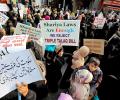
Women activists urged the government to withdraw the Bill from consideration in the Rajya Sabha, and review the fundamental flaws pending broad-based community consultations.

The board said that practices provided by Muslim Personal Law on the issues of marriage, divorce and maintenance were based on holy scripture Al-Quran and "courts cannot supplant its own interpretations over the text of scriptures".

'In the name of pluralism-secularism, the kind of politics that was pursued revealed to many that it was basically a favour to Muslim conservatism and communalism -- a politics of minority-ism, rather than of secularism.' 'This is how significant sections of Hindus have been made to loathe the very idea of Indian secularism by now,' says Mohammad Sajjad.

The bench had made it clear that it would examine whether the practice of triple talaq among Muslims is fundamental to their religion.

Most incidents of triple talaq are eloquent examples of the failure of Muslim society to instil in its men the teachings of the Quran; instead, they end up relying on the Quran's interpretation by local maulanas, says Ziya US Salam.
